Showing posts with label research. Show all posts

Friday, December 10, 2010

Two Birth Control Pioneers

A blog post by historian Deb Weiner.

Over the past few months, I’ve been working on the upcoming edition of Generations magazine, which will soon go to press. The theme of the issue is “Social Justice,” and without doubt it’s going to be one of our best ever. There will be orphans running away from the Hebrew Orphan Asylum and feminists clashing with male charity leaders in the 1890s, Communists sponsoring illegal “mixed race dancing” in the 1930s, rabbis and ordinary citizens taking a stand for civil rights in the 1960s. And (as always) much more.

For this blog post, I thought I’d highlight the career of Dr. Bessie Moses (1893-1965), who is featured in an article about ten Baltimoreans who stood up for social justice in the 20th century. Committed to women’s health care from an early age, she became the first female obstetrical intern at Johns Hopkins. In 1927, she and a few other doctors from Hopkins founded Maryland’s first birth control clinic, the Bureau for Contraceptive Advice (in the 1940s it became Planned Parenthood of Maryland). She was the clinic’s medical director, a post she held until 1956.

Dr. Bessie Moses

When the clinic opened, many of its activities were actually illegal according to the Comstock Law, which restricted the dissemination of contraceptives and birth control information. The clinic stayed on the right side of the law by positioning itself as a research institute—and it took its research mandate seriously, conducting important studies on birth control methods such as diaphragms and condoms. It also provided desperately-needed care to women who had nowhere else to turn. As a rigorous scientist and compassionate physician, Moses guided both the research and patient care components.

To avoid controversy that might lead to the clinic’s demise, it served only married women, mostly poor and working-class mothers who already had large families and couldn’t afford another mouth to feed. But Moses didn’t shy away from controversy on a personal level—she became a strong advocate for legalizing birth control, speaking out publicly and testifying at Congressional hearings for repeal of the Comstock Law. (In 1936, a federal court ruled that the Comstock Law did not apply to doctors providing contraception to patients.) Her clinic served blacks as well as whites, although on segregated days, as local custom demanded. In 1938 Moses founded the Northwest Maternal Health Center to serve black patients, the first women’s health clinic in the nation staffed by African American physicians.

Dr. Alan F. Guttmacher

Moses mentored another Baltimorean who became a nationally-known birth control pioneer, and since he didn’t make it into Generations, I’m glad to have an opportunity to mention him. Dr. Alan F. Guttmacher (1898-1974) was the son of Baltimore Hebrew Congregation Rabbi Adolph Guttmacher and his wife Laura, a feminist, social worker, and leader of local Jewish women’s groups in the early 20th century. He joined the birth control movement as an intern at Hopkins in the 1920s, “after witnessing a woman die from a botched abortion,” according to a profile on the Alan Guttmacher Institute website (more on that later). He became involved in Moses’s clinic, while also teaching at Hopkins and becoming chief of obstetrics and gynecology at Sinai Hospital. In 1952 he moved to New York and held a similar position at Mt. Sinai Hospital.

At age 64, Guttmacher retired from medical practice to become present of the national Planned Parenthood organization. The 1960s were a time of great change in the arena of reproductive rights, and Guttmacher was in the middle of it all, as perhaps the most visible advocate for expanding the availability of birth control and legalizing abortion. “No woman is completely free unless she is wholly capable of controlling her fertility, and … no baby receives its full birthright unless it is born gleefully wanted by its parents,” he stated.

In 1968, Planned Parenthood created the Center for Family Planning Program Development, which became the nation’s leading institute for research, education, and policy analysis related to reproductive health. After Guttmacher’s death, the institute was renamed in his honor.

Wednesday, December 1, 2010

Barry’s Blog

A blog by Dr. Barry Lever. Click the links below for earlier entries in this series.

Post One
Post Two
Post Three

The last blog recounted our research at the Edward C. Papenfuse Maryland State Archives in Annapolis, Maryland. It was there, in the microfilm records of the Baltimore County Court’s marriage licenses that we first encountered the name of the “Minister- Ansell,” who two days subsequent to the issue of the marriage license officiated at the wedding that the Golombek Ketubah documents.

We also pointed out that the July 14, 1845 license No. 273 was granted to Wolf Solden and Teressa Habal. This revealed the bride’s English name and clarified the groom’s last name to begin with the letter “S,” rather than a “G”
as initially interpreted on the Golombek Ketubah.

Another very important issue however is raised by these few entries. The spelling of the groom’s name Solden on the marriage license differs from the last name he personally inscribed on his own ketubah. The Golombek Ketubah records the spelling of the groom’s name as Soldin, spelled with the letter “i” rather than with the letter, “e.”

This is a graphic example of how an individual’s name could move from its original spelling in the person’s native language to a different anglicized spelling, and even to a complete name change. Because of these spelling and translation anomalies it is often difficult to ascertain whether or not a researcher is tracking the same individual in the historical records.

The marriage license entry for the name of the Minister,”Ansell,” opened an opportunity to explore and clarify the role, if any, that this individual played within the hierarchy of the historic Lloyd Street Synagogue.

In a 1905, on the occasion of the Baltimore Hebrew Congregation 75th Anniversary, Rabbi Adolf Gutmacher wrote the History of the Baltimore Hebrew Congregation: Madison Avenue Temple.Author Rev. Dr. Adolf Guttmacher
Title page
The Madison Avenue Temple

According to this Baltimore Hebrew Congregational record the congregation occupied four locations prior to the dedication, on September 26, 1845, of its new building now known as “The Lloyd Street Synagogue.”

Lloyd Street Synagogue, c. 1864, 1997.71.1
Photo by D.R. Stiltz & Co. photographers.
Courtesy of the Ross J. Kelbaugh Collection.


Lloyd Street Synagogue today.

Participating in these dedicatory events was Rabbi Isaac Leeser of Philadelphia.

Rabbi Isaac Leeser

At the time, Leeser was a prominent rabbi who also served as editor of the Occident, one of the first Jewish journals published in the United States.

In the November 1845 issue of the Occident, Leeser describes in great detail those dedicatory events under the title of “Consecration of a Synagogue at Baltimore.”

Click the excerpt to read the full article.

From this we learn that the marriage license Minister, Ansell,” functions as Baltimore Hebrew Congregation’s Hazon or Cantor. This is also confirmed on page 33 of Rabbi Guttmacher’s book, History of the Baltimore Hebrew Congregation, where we also learn that Cantor Ansell first name began with the initial “A.”


Our next blog will continue the exploration of the lives and times as revealed through the Golombek Ketubah.

I want to thank my colleague, Deb Weiner, JMM Research Historian and Family History Coordinator, for bringing the website for the Occident to my attention.

Wednesday, October 20, 2010

Barry's Blog

A blog post by Dr. Barry Lever - the first post in this series can be found here.

When one attends a contemporary hasanah, a Jewish wedding, the guests generally know the names of the bride, kalla, and the groom, hosan. One of the fascinating ketubah elements, however is that these legal documents only identify the bride and groom by their first names. These participants are linked for identification to their respective fathers, as the daughter of, bas …, or son of, bar … with the father’s name. However, no surnames are used.

An example of this is seen in the Golombek Ketubah, 2000.110.001*:

Close up of the English translation.

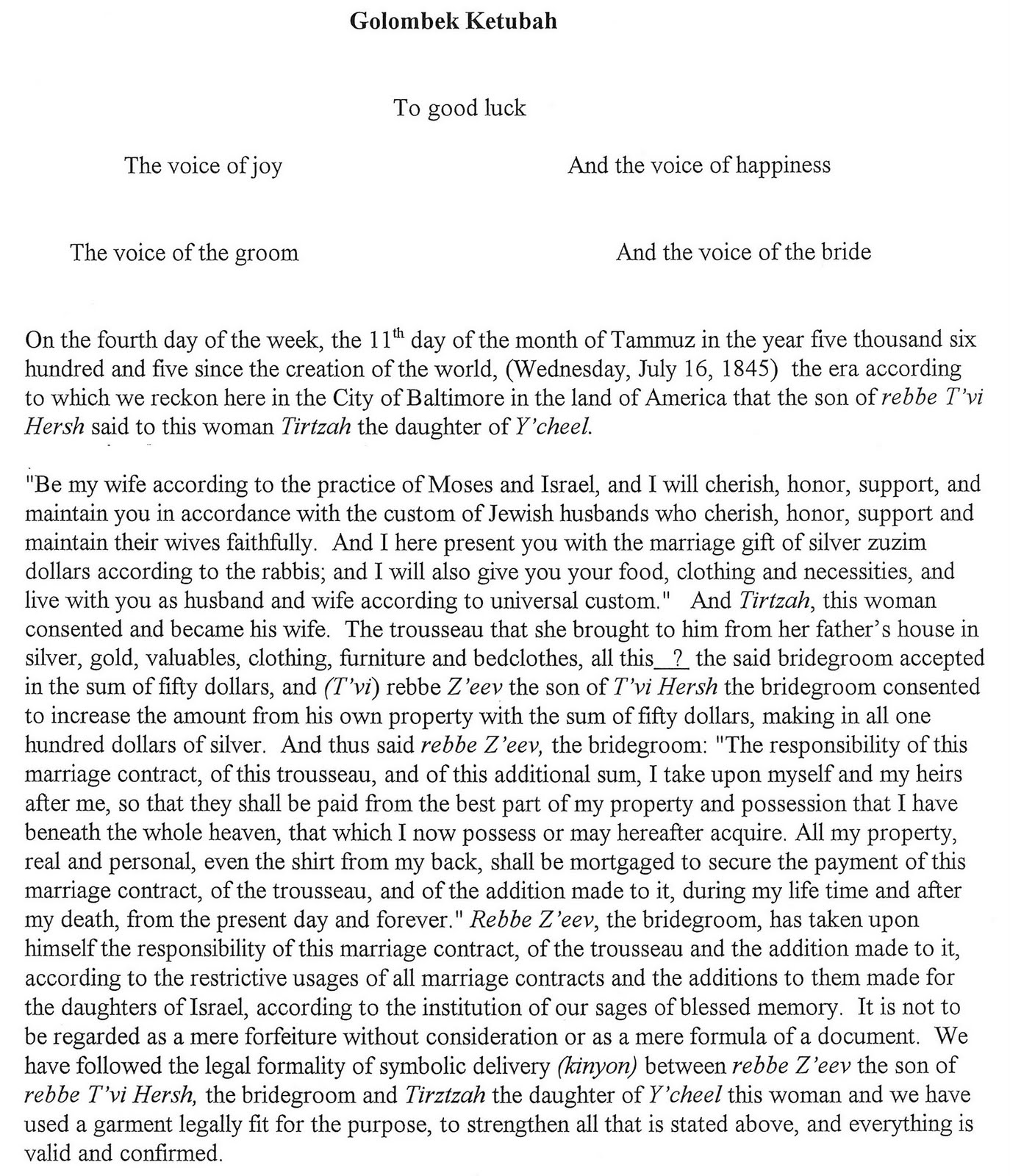
Here the hosan, groom is identified in the Aramaic original as rebbe Z’eev,* the son of, rebbe T’vi Hersh and the bride, Tirtzah the daughter of Y’cheel. *(Please note that the groom’s name, Z’eev was inadvertently omitted from this English translation.)

So if we are to continue our detective efforts to learn more about the lives and times of these individuals we need more information. Fortunately there is an additional clue within the Golombek Ketubah and possibly you have already discovered it?

To find this clue you will have to view the bottoms’ of the original scans, both of the Golombek Ketubah, and its corresponding transliterated Aramaic text both reproduced here.


Even though the signatures are written in an old style script they are the only feature of the document decipherable to an English reader. Unfortunately only the top two signatures are readily legible.

The first signature is that of “Wolff Golden, ha’chosen.” The English name, “Wolff” is a translation of the Hebrew name, Z’eev, previously noted in the document as the bridegroom.

The second legible script signature, “H. Habal,” appears to be a person of German origin because the two dots (..)over the second letter of his name. This “omlaut” is a typical diacritical Germanic language symbol that indicates the correct pronunciation of a word, in this case the person’s last name.

With these two names, the bridegroom’s given and surname name, “Wolff Goldin,” and the surname name of the witness, “Habel,” the exploration for additional clues about these individuals moves beyond the Golombek Ketubah.

Our detective efforts begin with the witness “H. Habal,” as it was not initially clear whether the bridegroom’s scripted last name began with the letter S, therefore making his name Soldin, or the letter G, making his last name, Goldin.

However, we quickly found the name, Harman Habel with the occupation of grocer listed in the 1845 and 1851 Matchett’s Baltimore City Directory, operating his store at 138 Orleans Street. His residence is also listed at the same location in the later directory.

1851 Matchett’s Baltimore City Directory

Interior page including the entry on H. Harman.

Close up on Habal Harman's entry.

Our search for more clues will resume with the November edition of Barry’s Blog! Enjoy the beautiful foliage of the new Fall season.

*A portion of the conservation of the item was made possible through the Betty & Leonard Golombek Philanthropic Fund. Gift of the children of Betty & Leonard Golombek in honor of their parents 50th anniversary.

Wednesday, September 15, 2010

Barry's Blog

Go ahead, be bold, take a guess!
What is this image and what does it represent?

Contained within the Jewish Museum of Maryland collections (JMM gift 2000.110) is this unique 1845 Jewish marriage contract known as a ketubah. It is printed in Hebrew letters using the classic Aramaic language and form prescribed for such a legal document.

It is this type of document that a Jewish husband presents to his wife during their wedding ceremony and details the husband’s obligations in their marriage.

How Close was your Answer?

A careful examination of this image reveals that the document is a pre-printed form, produced in bulk, on inexpensive paper, to be used by the purchaser to fill in the appropriate blanks and spaces with the date, place and names of the participants in the wedding. The meticulous conservation and restoration techniques required to keep this document from further deterioration can be noted by examining where the frayed and torn edges of the original document meet the conservator’s skills.

Even though it is a formal legal document it draws our attention, probably because the text is printed and centered under and within what appears to be a stylized huppa, a Jewish wedding canopy supported by two Corinthian columns.

The acquisition of this 13.75” x 8.5” ketubah and its restoration was made possible through a generous gift of the children of Dr. Leonard and Betty Golombek in honor of their 50th wedding Anniversary and at the JMM we proudly refer to it as the Golombek Ketubah.

So you ask, “What’s the big Deal?” Why is this document’s
acquisition and preservation important to the JMM?

The image below presents a Hebrew-Aramaic transliteration of the Golombek Ketubah text. This rendition was kindly provided by Rabbi Gershon Grayman, and any errors or omissions are strictly those of this blogger. (Click the image for a larger view!)

Now that you have read the text in an English font possibly things are becoming clearer? Not yet!? Alright, maybe the full English translation of the Golombek Ketubah will provide the key to the importance of this piece of ephemera.


The key to the Golombek Ketubah’s importance lies in its opening paragraph. If you read it carefully the calendar date, written out in Hebrew style, 5605, corresponds to the American calendar date, noted in the parentheses, (Wednesday, July 16, 1845) “…here in the City of Baltimore in the land of America….”

This document possibly presents us with a record of the first marriage ever to occur in the Baltimore Hebrew Congregation’s Historic Lloyd Street Synagogue.

There is much more fascinating material contained within the JMM’s, Golombek Ketubah. I hope that you also like playing historical detective and will share any thoughts or insights you can glean from this document.

Please watch for Barry’s Blog in October 2010 when we will continue with our exploration of the JMM’s historic Golombek Ketubah.*

Wishing everyone a shana tova, Healthy and Happy, 5771.


Dr. Barry S. Lever
Special Project Consultant


Here are some additional ketubahs from our collection!
Click an image to see its catalog record:


* Dr. Lever, wishes to thank fellow researcher, Ephraim Harel, Rabbi Gershon Grayman and Dr. Moshe Shualy for their help during this fascinating and serendipitous journey of discovery to better understand the history of the Golombek Ketubah.

Thursday, July 15, 2010

Teaching American History


Teaching American History


Think back to 5th grade US history. Did you get to read 18th century letters that talked about the formation of the United States? Did you get to see photographs of immigrants arriving in New York? Did you get to listen to a grown women recalling what it had been like to be a child during the Great Depression? Probably you learned history from your teacher and from the textbooks, and not from primary resources (AKA the actual old stuff). But this summer a group of teachers came to the JMM to burry themselves in the actual old stuff and use it for their own lessons. This happens every year as part of the Teaching American History summer institute – the program matches museums throughout Baltimore to teachers researching specific historical topics, with the aim of using primary resources to teach their students. Each museum provides digital copies of materials so that students can see and not just hear about what their teachers have seen. This year the JMM brought out archives related to: “Ethnic Relations in East Baltimore from the late 1800s to the early 1900s,” “Childhood in Baltimore’s Immigrant Neighborhoods,” “Discrimination,” and “Occupations of Immigrants in East Baltimore.” A lot of topics and a lot of researchers. I don’t often have five researchers in at one time – they kept me very busy for two days. More than two days actually.

Teaching American History researchers at work

Many of the teachers who take part in the program have not worked with archives before. As anyone who’s done research knows, it can get overwhelming very quickly, so we try and pull a selection of materials for the teachers – photos, traditional paper archives, maps, oral histories, etc. They can also search through our database to find something just right for their topic. Still it requires a lot of work on the part of the staff and interns (thank you Lindsay and Julia!!!!!!! They actually did most of the prep work.)

Lindsay and Julia

While the Teaching American History days do make a little extra work for me (and the interns), I also get really excited about it. I love primary sources (AKA the actual old stuff). To me that’s what makes history exciting. For me, a class about discrimination has more impact when the teacher can show how communities excluded others.

JMM 1995.201.001

A class about childhood in the 19th century can connect with kids better when they read or hear the words of the people who lived through it. The actual old stuff does make a difference.